Showing posts with label The Economy. Show all posts

Thursday, January 14, 2010

Could have Told you That!

December sales were down and 2009 a year of record bad retail numbers: Retail sales fell in December as demand for autos, clothing and appliances all slipped, a disappointing finish to a year in which sales had the largest drop on record.

The weakness in consumer demand highlighted the formidable hurdles facing the economy as it struggles to recover from the deepest recession in seven decades.

The Commerce Department said Thursday that retail sales declined 0.3 percent in December compared with November, much weaker than the 0.5 percent rise that economists had been expecting. Excluding autos, sales dropped by 0.2 percent, also weaker than the 0.3 percent rise analyst had forecast.

For the year, sales fell 6.2 percent, the biggest decline on records that go back to 1992. The only other year that annual sales fell was in 2008, when they slipped by 0.5 percent.

Our December was right in line with the rest of 4Q09, right around 20% off of last year's numbers. If there's an economic rebound but you've gone out of business, did it really happen?

Friday, January 08, 2010

Silver Lining

Energy prices fall in wake of bad jobs report.

Competing Views

The December job report hit today and was a disappointment for folks who thought the economy was turning a corner; Unemployment remains at 10% but the economy, rather than adding jobs, shed an additional 85,000.

Bob Stein of First Trust Advisers doesn't think it's all bad news:

However, the other data in the report suggest payroll growth will start again very soon. I say "again" because revisions to last months' data show that payrolls increased 4,000 in November, the first gain in two years. Two other positive numbers jumped out of the report. First, finance/insurance jobs increased 10,000, the most in three years. Second, temp employment — traditionally a leading sign of labor demand — increased for the fifth straight month. Meanwhile, the total number of hours worked in the private sector were unchanged in December, remaining 0.6 percent above the bottom in October. Given the economic growth we've had since the summer, the jobless rate probably peaked at 10.1 percent in October. Unemployment ticked down to 10.0 percent in November and held there in December. The jobless rate will not decline every month, but is likely to be significantly lower by late next year.

Hhhmmm. A glimmer of hope? Maybe. But then came James Pethoukis:

1. Remember this simple formula: Unemployment drives presidential approval numbers and presidential approval numbers drive midterm election results.

2. President Barack Obama’s approval numbers are hovering just a tick below 50 percent. Since 1962, the average House midterm loss for the president’s party when his approval is sub-50 percent is 41 seats. The GOP needs 40 to take the House.

3. And make no mistake, the December unemployment numbers were bad both economically and politically. The 85,000 job loss was worse than expected and will be played that way the media. The continuation of a double-digit unemployment also resonates with voters. And not a in a good way.

4. Then will come the second-take stories that will notice the shrinking labor force, which dropped by nearly 700,000 from November. Had it stayed stable for last month, the jobless rate would have been 10.4 percent. Had it stayed stable since August, the jobless rate would be 11 percent!

5. But wait, there’s more! The U-6 rate rate which combines the basic jobless rate, discouraged workers, part-timers-who-would-rather-be-full-tim ers climbed to 17.3 percent. And the average duration of unemployment rose to a record high 29.1 weeks.

6. Also, there is every indication that as the slowly growing economy eventually draws workers back in the labor force, the jobless rate will creep up to new highs. (Big companies remain cautious about hiring, and small biz remains under pressure due to tight capital markets.) The validity of the Obama recovery plan will seriously be cast in doubt.

7. The sickly labor market will also make is that much harder for the White House and Hill Dems to celebrate what is likely to be a brisk upcoming GDP report in the 4-5 percent range. That seems like an abstract number compared to the unemployment rate.

8. Combine a weak labor market – which may appear to be getting worse to voters – with the moribund housing market and rising gas prices, and you got a toxic triple threat that will be poisonous to Democratic incumbents and further drain Obama’s political capital

Granted, their takes come from different angles but what to think?

Thursday, December 03, 2009

It's still the economy, Stupid!

Byron York highlights the assessment of Democrat operatives James Carville and Stan Greenberg. It aint pretty:

All in all, it's a perilous situation for Democrats taking their House and Senate majorities into next year's elections. "The slow recovery and continued job losses, combined with Wall Street bailouts, big bonuses, government takeovers, deficits and possible gridlock are an ugly brew," Carville and Greenberg write. "For Democrats to reverse the slide in their standing, they need to focus with urgency on jobs."


Urgency -- that's the key word, and the reason for Obama's "Jobs Summit." But voters know Democratic leaders haven't shown that urgency about jobs, and are in fact working 24/7 to pass a national health care bill that isn't the country's top priority. What "The Economy and Politics of 2010" shows is that this could be a very costly mistake.

Suffice to say, if they keep doing what they're doing Congressional Dems will get slaughtered. There will be collateral damage in Republican seats but the Dems will get slaughtered.

Friday, November 13, 2009

Monday, September 14, 2009

Smartest President Ever?

Does this sound smart to you?:

Trade relations between two of the world’s biggest economies deteriorated after Barack Obama, US president, signed an order late on Friday to impose a new duty of 35 per cent on Chinese tyre imports on top of an existing 4 per cent tariff.

Smart Presidents don't start trade wars.

Saturday, September 05, 2009

Friday, September 04, 2009

It's BS alright...

More like strategic Bull-shot...the country's smartest VP-ever, Joe Biden, on the stimulus yesterday:

"...the fact is, the Recovery Act is a multi-faceted piece of legislation. It doesn't reflect a lack-of-design, that was the design, that was it's intended design.

Our economy is so complex and so wounded that re-invigorating one segment alone or using one tool alone would never, would never do all that needed to be done. The Recovery Act is not a single silver-bullet. I think of it as silver-buckshot as opposed to a single bullet.

In 200 days the President's Recover & Reinvestment Act isn't just working towards something...see it isn't just working, it's working towards something, it's working toward a more resilient, more transformative economy."

Wha?

It's BS alright, silver or otherwise...

Thursday, July 23, 2009

Encouraging sign

On the economic front today, this headline:

Gold prices flat as investors' risk appetite grows

Friday, July 03, 2009

That wasn't supposed to happen


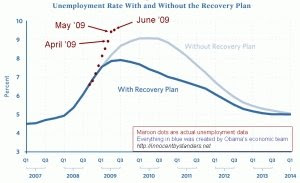
Unemployment jumped again in yesterday's report. Them's the brown dots. What the Obama Administration promised--both pro and con--for the Stimulus plan are those two lovely curves below that steep line you see if we connect all those dots. You remember...unemployment topping out at 8.5% vs. 9%.


Well, we're at 9.5% and far more likely to blow through 10%--a number not seen since 1982--than not. What do folks have to say about it?


Well, this is pretty self-explanatory: Be sure to thank the President and Congress. This week, with news of some 467,000 jobs lost in June, the Bureau of Labor Statistics estimates that the U.S. has now lost about two million jobs since the economic stimulus package passed. Even more notable is that the average workweek has been slashed to 33 hours - the lowest number on record. When the President signed his $787 billion stimulus package into law, he confidently asserted that unemployment would not exceed eight percent. If Congress hadn’t passed it, he warned, it would rise to nine percent by 2010. Well, unemployment reached 9.5 percent last month, meaning, by the President’s own logic, that his stimulus package has failed.


And Jennifer Rubin pulls no punches: We are recovering. But unemployment is getting worse. And the stimulus is definitely working. Got it? It sounds like they haven’t a clue what to do and don’t want to admit they have been concocting a disaster. And we shouldn't pick on Gibbs. The president and the rest of the administration are no better:...


And what of John Q. Public? Well, how 'bout this: A Rasmussen video report notes that 42% now give the President good or excellent marks for handling the economy . That’s his lowest rating to date...


I expect that, and the approval ratings that go with it, will fall even further when we break 10%, assuming we do (and I feel pretty confident that's much more likely than not). At the risk of sounding like one who is just having fun switching roles from Bush Apologist to Obama critic, I must refute such an allegation, should it come.


The hallmark of President Bush's critics over his 8 years in office, by far, was anger, mixed in with a little irrational hatred of a man 99.9% of them never met much less truly know. The final ingredient in this vile concoction was the fundamental lack of respect for all who disagreed with them about the President and his policies.


President Obama is my president; while I did not vote for him, I will support him when I think he's right, I will be critical when I think he's wrong and I will always show him the respect he deserves. I am not angry with the President over Guantanamo Bay, Iraq or the economy. I think his decisions have been incorrect, but I am not angry.


To the contrary...on the economy I'm actually laughing. I knew his proposal couldn't and wouldn't do what he was promising. I'm sad to see that we're forced now to wait out more difficulty than we otherwise would as a result of his policies. But that is where we're at.


What I patiently wait for is the Administration and it's supporters to finally acknowledge that they own what is now happening in the country. George W. Bush is no longer President; the Democrats who have controlled Congress for 3 years have made every effort at ensuring his policies are no longer in place.


To the Administration and it's supporters, man up! Own your failures. It'll make it far easier to own your successes down the line.

Thursday, June 25, 2009

A Ricky Ricardo Moment

Fed chair Ben Bernanke gets the Tenth Degree up on Capitol Hill today about the B-of-A/Merrill-Lynch deal. Of it, Megan McArdle at The Atlantic has this to say:

I'm on the record as thinking Bernanke has done a pretty good job in a pretty scary crisis. Nothing I've heard recently has changed my mind on that. However, I have to say, watching his testimony to Congress today, I suspect that he's not going to be reappointed when his term ends next year. Whatever happened between him and Paulson and Ken Lewis, he is now giving a very good impression of someone who is lying. And Congress wants someone to blame. Besides, firing Bernanke lets Obama portray all of the failures of this year as Bush errors in policy or appointment.

That would certainly fit the President's MO. As best I can tell, nothing bad happened prior to the election of George W. Bush in 2000 and nothing could possibly go wrong now that he's out of office. This despite the fact that President Obama has 6-months worth of fingerprints on public policy and the US economy; most famously the Ginormous Stimu-palooza that was going to save us from double-digit unemployment once passed.

The President's rhetorical skills not withstanding, he will sooner rather than later own US Foreign policy and the economy as well. What will he say then?

Me thinks he'll have an awful lot of 'splainin to do...

Friday, June 19, 2009

The Gambler

James Pethokoukis (one of the few econ reporters around who goes out of his way to write accessibly on his beat) wrote an interesting post at his new digs today about changes in public perception of President Obama's economic policies. Key points:

Okay, here’s the thing: Obama took a tremendous economic and political gamble last January. The new president had the option of putting forward a stimulus plan that would attempt to reverse or significantly dampen America’s terrible economic downturn ASAP. The quickest and most effective approach would have been a big cut in payroll taxes. For $800 billion, combined Social Security and Medicare taxes could have been slashed by 6 percentage points, or 40 percent. That would have put $1,500 in worker paychecks and, according to one credible study, increased employment by 4 million jobs in 2009.

Instead, Obama chose to listen to Rahm “Never let a crisis go to waste” Emanuel and put forward an $800 billion plan that advanced his healthcare, energy and education policy goals — but pretty much neglected the economy in 2009. Team Obama had to fully understand this. Indeed, a study from the Congressional Budget Office study — when led by current Obama budget chief Peter Orszag — concluded that an Obama-like economic stimulus package would be “totally impractical” because it would take so long to implement. (True enough, only seven percent of the American Recovery and Reinvestment Act has been doled out so far.)

Presidential gamble. In short, Obama wagered that the deluge of money coming from the Federal Reserve would do the heavy lifting as far as stabilizing the financial sector and keeping the already apparent recession from turning into a real disaster. Voters would, thus, continue to support his policies to assert more government control over healthcare, heavily regulate energy through a costly cap-and-trade program and further intervene into the financial industry.

The gamble appears to have failed miserably, both economically and politically. The terrible tale of the tape: a) the current downturn is arguably the worse since the Great Depression; b) household wealth has fallen by $14 trillion during the past two years, including the first quarter of 2009; c) while the economy may not shrink as much this quarter as it did in the previous three months (-5.7 percent) or the final quarter of 2008 (-6.3 percent), unemployment is soaring; d) Obama himself said the jobless rate will hit 10 percent this year; d) even worse, the Federal Reserve sees it approaching 11 percent next year. (Recall, that the original White House economic analysis of the Obama economic plan never saw unemployment exceeding 8 percent if Obamanomics was passed by Congress.)

Falling public support. So now many Americans are rightfully wondering just what they are getting for that $800 billion, as well as massive budget deficits as far as the eye can see. And it goes beyond the mercurial world of polling. Pricey plans to deal with perceived climate change and healthcare are also appear on the ropes or are being scaled back as voters view them as lower priorities than job creation and taming out-of-control spending.

As a couple of the dissenting comments point out, the post includes a number of assertions yet to be proven. I thought however that overall the piece makes a good-faith analysis.

Is he right? No clue and my crystal ball is broken; only time will tell us that.

The more conspiratorial view would be that the President back-loaded the stimulus for obvious political reasons with most of the spending occurring in 2010-12. The question then is what do the economic numbers look like and if as bad as they may be, will people forgive the worst unemployment in a generation, the return of inflation and most-likely slow growth when stimulus spending starts in earnest?

The President may have in fact made that very bet.

Saturday, September 06, 2008

The Kudlow Effect

The Kudlow Effect in action:

Since oil prices peaked on July 3 and started to head down, airline stocks have taken off, lifted by the promise of lower fuel prices. Of the 21 publicly traded airlines, shares of all but two rose from July 3 to Sept. 2. The major carriers had sharp gains: US Airways, up 268 percent; UAL, parent of United Airlines, up 222 percent; AMR, parent of American Airlines, up 138 percent; Continental Airlines, up 97 percent.

Friday, February 08, 2008

The Height of Economic Illiteracy


Stop the war, fix the economy:

Forty-eight percent said a pullout would help fix the country’s economic problems “a great deal,” and an additional 20 percent said it would help at least somewhat. Some 43 percent said increasing government spending on health care, education and housing programs would help a great deal; 36 percent said cutting taxes.

“Let’s stop paying for this war,” said Hilda Sanchez, 44, of Waterford, Calif. “There are a lot of people who are struggling. We can use the money to pay for medical care and help people who were put out of their homes.”

The subject of leaving Iraq shows a sharp partisan divide — 65 percent of Democrats think it would help the economy a lot, but only 18 percent of Republicans think so.

Oy...

Saturday, January 19, 2008

Bad Mood Rising

VDH wonders about California's Groundhog day:

Our poor state is $14 billion plus now in the red, and the Governator has promised no new taxes, wise inasmuch as our sales and income taxes are already among the highest in the country. The University of California system is panicking and sending out emails to us alums, to march en masse on Sacramento for redress!

But lost in the furor is any self-reflection, such as why would UC Davis recently pay John Edwards, multimillionaire trial lawyer, $50,000 plus to give a brief lecture on poverty? Such questions are never answered, much less raised, since the problem is always framed as a matter of a shortage of income, never a surfeit of unnecessary expenditure.


We in California, given the past budget implosions, know the script to follow. We expect that police, fire, prisons, parks etc will be threatened with cut-backs and closure while the state-funded "Center for this" and the "Department of that" will remain untouched, since cutting the essential while protecting the politically-correct superfluous is the only way to scare the voter and achieve higher taxes.


At some point we Californians should ask ourselves, how we inherited a state with near perfect weather, the world's richest agriculture, plentiful timber, minerals, and oil, two great ports at Los Angeles and Oakland, a natural tourist industry from Carmel to Yosemite, industries such as Silicon Valley, Hollywood, and aerospace—and serially managed to turn all of that into the nation's largest penal system, periodic near bankruptcy, and sky-high taxes.


I suspect that there can be no meaningful compromise in the capitol...not when Democrats in the legislature long to increase taxes and the Governor--for whatever it's worth--keeps saying he won't do such a thing as Hanson points out. So now what?

In the meantime, real estate continues to take it on the chin--the house next door has been on the market for over a year and the owner can't unload it even with a fire-sale sticker of $289,000.

I'm upside down to the tune of $30-$40K on mine, revenues are way down yr-to-yr at work and my income for '07 was down a cool 10% from '06 while the outlook for '08 is no better.

So yes, now what?

Friday, October 26, 2007

Eternal Pessimists

It is a continual dilemma...is the glass half-full or half-empty? Pessimism abounds in the media.

These links today struck me as perfect examples of how every silver-lining has a cloud:

Joe Klein of Time is fishing for bad news in Iraq:

The apparent progress raises two questions: First, as always, what's the catch? And second, if the progress is real, if the Sunni extremists have been routed, if Baghdad has been ethnically cleansed to the point of near pacification, if the bottom-up reconciliation efforts are gaining momentum, what is the U.S. military mission now? Why can't we start bringing home the bulk of our troops immediately?

Paul Krugman, the pessimist's pessimist is at it again. The naysayers were right and the rest of wrong. As usual.

Krugman is actually right this time and there are plenty of negative things to be said about the sub-prime lending mess that we're working ourselves through these days. Krugman's problem, however, isn't his argument or logic--as I said, he's right on this.

It's the persistently and routinely pessimistic outlook that gets him in trouble. He's been predicting recession for going on 5 years now.

Like the proverbial blind squirrel who can't help but stumble upon an acorn, he's bound to be right at some point. But in the meantime, he's cried wolf so often I'm left wondering who is left to hear, much less heed, his warnings.

Saturday, July 07, 2007

Ponderiffic

I think about these kinds of things since I work in sales and depend on the good fortune of others for my own:

More good news came from the June income numbers: Real wages for workers—not managers—increased by 3.9 percent, year over year. Deflate by the core May inflation rate of 2.3 percent—the latest numbers available—and you get real wage growth of 1.6 percent. Not too shabby. Right now, Wall Street recession expectations are pretty low. "The threat of recession has abated, as job and income gains provide the wherewithal to support consumer spending," is the analysis of former Federal Reserve governor Lyle Gramley. In fact, the Big Money Crowd is more worried about China than U.S. housing as a source of future trouble. Case in point: this missive "What Would the Next Recession Look Like" that Goldman Sachs just sent me:

"So, what constitutes a recession in modern times, and when do they occur?...We suspect it would almost certainly involve a major economic slowdown in China. On almost any criteria (and topic), it is impossible to underestimate China's positive impact on the buoyancy of world growth this decade. That said, our China proprietary indicators show no sign of an imminent slowdown. In addition, our various proprietary indices suggest that the underlying global macro environment remains favorable...Moreover, if we and the consensus are correct, then the period 2003-2008 will have been one of the most powerful periods of economic growth globally since accurate data has been collectable for much of the world."

Friday, May 11, 2007

Walmart is what it is

Jim Cramer reviewed the current retails sales figures this morning on Today and in the course of that discussion makes an interesting comment about Walmart. You can find similar sentiments here and here.

  • Better Living: Thoughts from Mark Daniels
  • Evangelical Outpost
  • One Hand Clapping
  • Camp Katrina
  • TPMCafe
  • Dodger Thoughts
  • Boy of Summer
  • Irish Pennants
  • tabletalk
  • Fire McCain
  • My Sandmen
  • Galley Slaves
  • Michelle Malkin
  • myelectionanalysis
  • Iraq the Model
  • Mystery Pollster
  • A Bellandean! God, Country, Heritage
  • Right Truth
  • The Fourth Rail
  • Counterterrorism Blog
  • Just One Minute
  • Broken Masterpieces
  • Kudlow's Money Politic$
  • Econopundit
  • Tapscott's Copy Desk
  • The Blue State Conservatives
  • Palousitics
  • Christian Conservative
  • Outside the Beltway
  • The Belmont Club
  • Froggy Ruminations
  • The Captain's Journal
  • Argghh!!!
  • Chickenhawk Express
  • Confederate Yankee
  • Reasoned Audacity
  • Taking Notes
  • ThisDamnBlog
  • Three Knockdown Rule
  • Dogwood Pundit
  • Dumb Looks Still Free
  • Unfettered Blather
  • Cut to the Chase
  • Alabama Improper
  • Austin Bay Blog
  • Michael Yon-Online
  • The Trump Blog
  • A Lettor of Apology
  • GM Fastlane Blog


  • Powered by Blogger

    Listed on BlogShares Who Links Here