Thursday, February 23, 2006

People in the Know

One of the great things about blogs is how they bring expertise in all sorts of fields straight to you at home or in your office. Often some of the best analysis in politics and sports and other important areas of life are occurring here in the blogosphere and not in your local newspaper or weekly magazines.

In such situations, knowledge and immediacy are combined in a way that gives the blogs impact. To wit, I give you Stephen Spruiell at NRO and this post on the DWP port deal:

Alistair McNab, president of the Greater Houston Port Bureau, said, "The total lack of understanding displayed has been unconscionable."

"They're going to be operating a terminal as a tenant," McNab said. "The Port Authorities are still in charge. I've seen these statements that Dubai Ports World is 'taking over' these ports. The statements in my view are designed to inflame passions rather than to give the truth. There are so many misstatements it's breathtaking."

Through the GHPB, McNab has worked with other maritime associations to internationalize maritime security regulations. He said that critics of the plan don't seem to get it. "The U.S. Coast Guard has taken the lead on port security not just in the United States but around the world since the Homeland Security Act in 2002. It hasn't just been U.S. legislation, but International Maritime Organization (IMO) legislation which paralleled the new U.S. security paradigm. The world standards through the IMO were driven by the U.S. Coast Guard. We got just about everything we wanted regarding port cargo and personnel security. It's not just the U.S. --the whole world is on the same page. It doesn't matter if it's a port in New York or Dubai or Sydney-- we all comply with the same regulations. There is worldwide enforcement. We feel quite pleased that the U.S. took a leadership position in enacting the kind of international security regime we envisaged. All that was done through the Department of Homeland Security but particularly through the U.S. Coast Guard."

The USCG takes a lead role not just in setting security standards, but enforcing them. It collects a mind-boggling amount of data on all vessels, cargo and crew entering the United States, which is then subjected to a deep analysis. If anything seems out of line, the USCG boards the vessel before it gets anywhere near a port. In his article, Sanger includes the oft-cited statistic that "Only 4 percent or 5 percent of those containers [entering the U.S.] are inspected." But that statistic only applies to the containers that are randomly inspected by Customs above and beyond any containers triaged out of the supply chain because their documentation has raised a red flag or they come from someplace like Gaza and deserve extra scrutiny. And to randomly inspect a much larger percentage would incur economic losses in excess of the potential benefits of checking out every container of tube socks bound for Wal Mart.

We can all agree that profiling makes sense, right? And we get angry when we see little girls getting hassled at airports, don't we? So why are we suddenly attacking a port-security regime that applies a more rigorous set of rules to any cargo coming from suspicious destinations and refuses to overdo random inspections?

Food for thought. While we chew on that, consider how bloggers can find these people while Big Media cannot.

Bi-partisan stupidity

Normally when I talk about stupid political rhetoric, I'm usually talking about Democrats.

Just so we're all clear, I'm an equal opportunity kind of guy. And to prove it, I give you Congresswoman Sue Myrick, R-North Carolina:

Dear Mr. President:

In regards to selling American ports to the United Arab Emirates, not just NO - but HELL NO!

Sincerely,

Sue Myrick

Wednesday, February 22, 2006

A port in any storm

I'm kinda like this guy at the Corner:

I found Rummy's presser yesterday interesting. Apparently our Aircraft Carriers regularly make port call in the UAE and are serviced supplied etc. Apparently we have excellent military to military cooperation with the UAE including selling them US made aircraft etc.

Gen Pace Joint Chiefs said that the UAE lets us use their airspace, bases, helps maintain the bases. Apparently they have done that even during war time when we really need it with no hassles.

It may be that the Administration insiders have long come to terms with the conflict that comes from all the above positive info (there is much more) with the fact they the UAE do not recognize Israel.

It seems that the W team has comprehensively bungled the internal and external sales effort on this. The underlings may have not realized how sensitive the issue would be and did not plan and execute a full sales and communication plans that alerted the top players in all the depts.

Given that actual security is still the responsibility of the US Gov. Agencies, Coast Guard, Customs etc. and that we berth our Carriers in the UAE, fight wars in the Mid east with UAE help, I think it's hard to argue that this port deal is unacceptable.


My mind is still open and ready to absorb more facts. Given what I know so far I think this is a sales and PR disaster but the merits of the matter don't seem nutty.

There's no imaginary-universe in my mind where a President could be as poor a communicator as this one is.

Meanwhile, all kinds of folks have waded into this debate from all sides with all kinds of rhetoric.

Michelle Malkin takes on supporters of the deal.

Mansoor Ijaz at NRO takes on the deal's detractors: Washington's bout with Islamophobia also ignores the reality of Dubai's future direction. A metropolis already, it is rapidly becoming the prototype city-state that could serve as an important example for the future in Muslim societies bedeviled by high unemployment, low literacy rates, bad trade policies, and authoritarian political structures. It is managed and led by a cadre of young, highly educated Arab and Muslim professionals who seek to transform the world's stereotype of Islam by developing and running businesses transparently, with integrity and with an increasingly democratic and accountable corporate culture.

Whatever the UAE's policies in the pre-9/11 world (whether as home to A. Q. Khan's illicit nuclear network, one of three Taliban embassies, questionable banking practices, or as an alleged repository for Iranian-terror funds), Dubai's record under these young leaders in the post 9/11 world reflects serious and structural change in national strategy.

Hugh Hewitt looks at the nuts-and-bolts in an interview with Admiral Craig Bone of USCG, and the Director of Port Security in the Maritime Safety, Security, and Environmental Protection Directorate:

As I expected, Admiral Bone is an impressive expert on port security and confident of the ability of the Coast Guard to maintain port security no matter which company runs the ports. He was a candid and obviously informed expert on the operations that Dubai World Ports will assume if the deal goes through.

But he does not allay my concerns that the overall burden on the security forces has to increase when a foreign company based in an Arab country with a significant history of al Qaeda operations takes over a port. The Admiral correctly points out that American security depends on extending our borders out far beyond our geographical borders in terms of intelligence collection and cooperation with friendly allies like the UAE.

Still confused? Good, I'm not the only one.

More Scenes from The Middle of Nowhere

Is that a word?

Tuesday, February 21, 2006

My Dogs are Smarter (Or, about Dealing Dogs)


Earlier this evening I caught the premier airing of HBO's documentary Dealing Dogs:

Four years in the making, DEALING DOGS follows the undercover investigation of Martin Creek Kennel by the animal rights group Last Chance for Animals. A young man who goes by the name of "Pete" in the film wore a hidden camera while he worked a low- level job hosing kennels at the dog dealer. Over the course of six months, Pete secretly filmed activities at Martin Creek Kennel, including the beating and shooting of dogs, and recorded footage of animals that were left to languish in their kennels and suffered from malnourishment, life-threatening disease and injury, among other abuses. Dog corpses are shown piled up on the property and in trenches after being butchered for their organs.

I'm not an animal-rights activist. I think PETA is out of their ever-loving, collective mind.

Even in the face of something rotten like this, I pride myself in keeping perspective. Animals are not people; while it is difficult to imagine the effects of "medical research" on dogs and cats, the simple fact is that such is less grievous than seeing people die or suffer with conditions that can be helped through such work.

Having said that though, this film made me want to be sick. Seeing a wanton disregard for the animal's well-being, the abusive treatment of defenseless dogs made me angry. Very angry...

My dogs are smart; they are also very lucky. Tonight they'll get an extra treat and a few more minutes with dad. I think I need it even more than they do.

Resigned

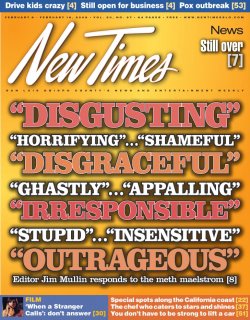
On the way to work this morning I was caught somewhat by surprise to learn that New Times editor Jim Mullin had resigned. Publisher Bob Rucker has insisted that the timing has nothing to do with the publication and resulting backlash over the "Meth Made Easy" piece published earlier in the month. How that is possible though, I have no idea.

Area radio host Dave Congalton reported yesterday that Mullin resigned on Friday: Word came out around town today that Jim Mullin, controversial New Times editor, has resigned after less than two months on the job. Mullin, as you may recall, lived in Miami, yet edited our weekly alternative newspaper from home, raising more than a few eyebrows in the process.

While surprising to learn, Mullin's 'tele-editing' at least answers the question about how an editor could be so tone-deaf about the market he serves as to run such a piece. Congalton also pointed out a couple of weeks back that Mullin has a history of similarly poor judgment and/or bad behavior:

But more importantly is (2) Who exactly is Jim Mullin? He's listed as the new editor of New Times and he came on board in January with zero fanfare. I don't know Mr. Mullin and I have nothing against him personally, but I believe there are at least three examples that suggest he is a bad fit for the job. Keep in mind that Mullin doesn't even live on the Central Coast. He lives in MIAMI, FLORIDA and tele-edits.

Anyway, the examples. First, I ask you to go Google "Jim Mullin Miami New Times" and see what you find. Mullin was forced to step down as editor of Miami New Times last August following a PUBLIC UPROAR (sound familiar?) because his paper outted a local public official. Following the publication, the man killed himself. Do the research yourself.

Congalton also today posted a letter, ostensibly from Mullin to SLO Tribune staffer Leslie Griffy that reveals a snarky and near-bitter man. I stick by my assessment, one echoed by Congalton, that Mullin is only sorry for the backlash and not for his poor judgment:

Many thousands of copies of that February 2 issue were stolen by individuals who, in their roles as self-appointed community censors, decided that others should not have the opportunity to read the story and make their own judgments as to its merits. Yet we heard nothing from the Tribune about this brazen abridgement of New Times’s First Amendment right to publish the story and the public’s right to read it. Does the Tribune condone the confiscation of publications that contain controversial material? Would the Tribune sanction the theft of its own papers under similar circumstances?

The Tribune, it seems, has arrived much too late for this party. That should embarrass its editors and reporters, but not as much as the paper’s shameful silence in the face of actions eerily and frighteningly reminiscent of book-burning in Nazi Germany. A Constitutional right in which the Tribune has a vital interest was trampled in its own back yard, and what was the response? Silence.

True, but so not the point.

The New Times faces a difficult road in winning back readers and advertisers (if reader response is emblematic of real opinion). Surprisingly, I would find myself agreeing with Congalton's analysis: The community has a vested interest in New Times succeeding. We need that alternative voice. Let's hope for better days ahead.

Monday, February 20, 2006

Scenes from The Middle of Nowhere


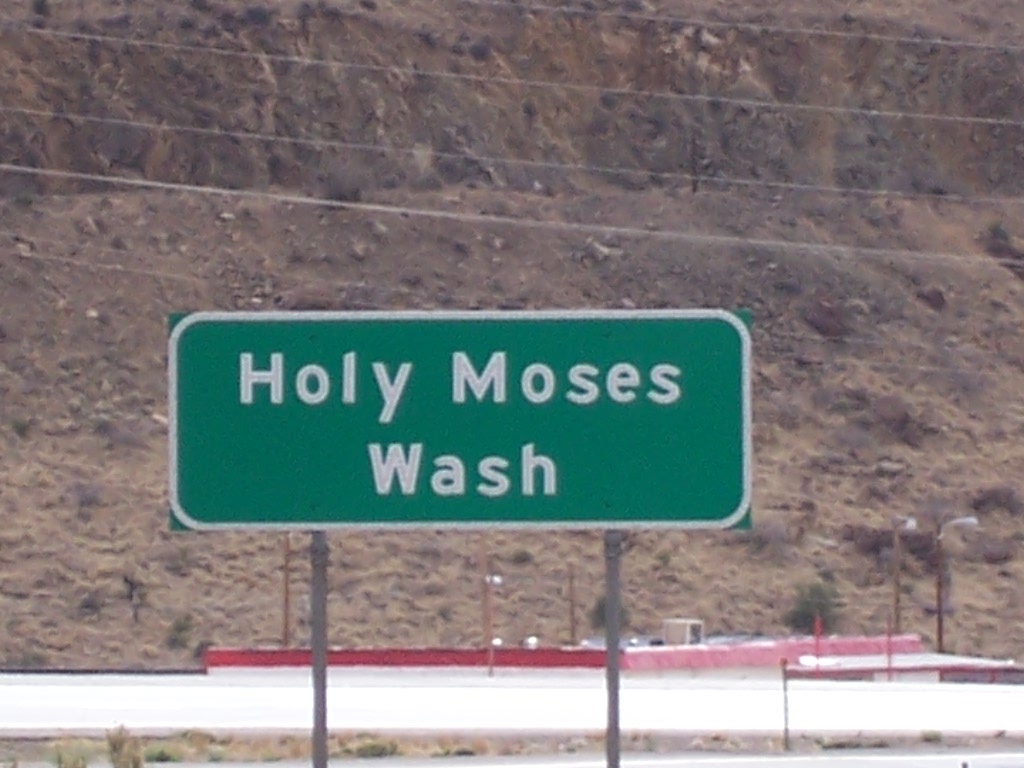
A few miles outside Nowhere, Arizona.

Things that make you go, "Hhhmmm."

After two hours on the road Friday morning, we made a quick pit stop near my childhood home. The place doesn't look anything like the town I grew up in, but I had noticed in the past that they'd finally joined the 21st century when Starbucks went in right near the freeway.

We pulled in to grab a coffee and hit the restroom. While I waited for my wife, I perused my once-local newspaper and saw an interesting headline or two:

A man who showed up unannounced Thursday at a Navy base gate sporting a serious rash and skin lesions sparked a long quarantine and fears of smallpox before health authorities determined it was only chickenpox, officials said.

Sunday, February 19, 2006

Whose idea was this anyway?

I don't normally watch This Week on Sunday mornings. In the day it was my preference for Sunday talkers--David Brinkley was smart and always fair and his panel was always entertaining. What George Stephanopoulos has done to the program need not be mentioned here, it's been chronicled elsewhere. What I wonder is how a Katrina vanden Huevel gets a seat at a table where people--anyone!--are trying to discuss serious issues!

Vanden Heuvel, editor of The Nation is an outspoken liberal and has no compunction about stating her opinion on all-things Bush related. I don't know if she's a regular or rotating guest exactly. Frankly, I don't care, but she was the guest panelist today with the George's and Cokie Roberts.

The panelists gathered after Stephi's interview of Michael Chertoff, discussing Dick Cheney's week and the Congressional findings on Hurricane Katrina. Hearing her speak, I at least now understand where some of the buffoons at ESPN get their schtick.

She pontificated on multiple occasions about Dick Cheney's shooting last week as grand metaphor for the super-secretive Bush Administration (standard left-wing blog fare) to the point that George Will had to slap her down with some common sense commentary about politicians and the accidents that happen to them. Honestly, I got the impression as I watched Will based on his face and body language that in a less-polite setting he'd have blasted her for the nonsensical rhetoric she was spouting. I know I would have.

The point that got me however was a few minutes later when Stephi brought up the Palestinian elections, whereupon she began a long rant which began with, "We've witnessed the abject failure that is the Bush Administration foreign policy..." to describe the President's vision of a ME transformed by democracy.

Utter ridiculousness in light of 3 elections in Iraq last year, the freest elections in Egypt in decades and the Cedar uprising last spring. She points out that Hamas in charge is not a good result for the United States (which it isn't) and uses it as a club to bash the administration.

What she doesn't acknowledge is that democracy isn't easy and you don't always get everything you want. Her rhetoric begged a question that no one asked her on this topic: what would she say if the Administration had backed a results-specific policy aimed at promoting a "free" election with a favored winner?

She wants her cake and to eat it too. But then I shouldn't be surprised by someone who publishes stuff like this.

Mucking around in mire

Read this and be disgusted.

Friday, February 17, 2006

Just in case...

we invade Iran on the basis of non-compliance with the demands of the international community regarding it's nuclear ambitions and we get to Tehran and find no nuclear weapons stockpiles, but only "nuclear weapons program activities," and the opposition cries foul because of cherry-picked intelligence, bogus intelligence and outright lies by the U.S. Administration, let's just try to remember that this was said by a French nuclear negotiator prior to the war:

"No civilian nuclear program can explain the Iranian nuclear program. It is a clandestine military nuclear program," Douste-Blazy said on France-2 television.

On the road again

Sim has been on the road this week. I hit the road this morning.

My grandfather's 95th birthday is today and we'll be celebrating with the rest of the family at his home in Kingman. We certainly expect it to be a different kind of celebration this time around, in light of recent events.

So just when you thought it can't get quieter or darker around here, it just might. Though I have it on good authority that Sim has some surprises tucked up his sleeve for the weekend.

Apology or Apologia? (Part II)

The New Times-SLO continues to face criticism and a loud and vociferous negative reaction to it's story published two weeks ago now on Meth. To the point that the paper was forced to respond last week to the growing outrage.

In part I, while primarily addressing the papers 'apology' for running the story, I touched on the negative reaction they've received:

The negative reaction has continued and grown in the week since in both numbers and strength. More importantly for the New Times (and also for their sister pub the Santa Maria Sun though to a lesser degree) it has extended itself to include their advertising roster.

So what exactly have people been saying? A lot. Editor Jim Mullin's apology was followed by pages of short letters sent to the New Times in reaction to their piece. Here is a sampling:

--The article had no redeeming value and was nothing more than an abuse of power in order to push the limits of decency. I can’t begin to tell you how incredibly insensitive and irresponsible the article was. I sincerely hope that all of you who allowed and supported this article feel the wrath of the community that trusted your publication into our homes and businesses.

Chris (a 21 year old reader who fits nicely in the 'alternative' weekly demo)

--as a result of your article and your editor’s decision to run this article, I can no longer tacitly recommend it as a reference for my courses. Until the editor or publisher of New Times retracts support of the publication of this article, I will also urge any business I patronize to discontinue distributing the paper.

Keith
San Luis Obispo

--As owner and general manager of Robin’s Restaurant, I am really torn about continuing to advertise with New Times. I will see what your next issue is all about, then decide. I feel I cannot support a newspaper that does not promote the well-being of our society by printing such articles like “Meth Made Easy.”

Shanny Covey

My personal favorite:

--As a card-carrying member of the ACLU and self-avowed liberal, I was extraordinarily disappointed in the poor judgment shown by the running of the meth cover story. This over-the-top and out-of-control journalism is exactly the kind of tripe the radical right uses to paint all liberals with a broad brush. I suspect this did not inflame as many conservatives who would blow this off as “one more example of liberals who are out of their minds” as much as it infuriates those of us who agree strongly with many of the views you espouse in New Times. But this article is one that goes past freedom of speech and into an area of decency and general community welfare. I still do not understand what your intent was in writing and publishing such a piece. To promote very liberal and radical views, I applaud. To promote something like the manufacturing, use, and sale of meth is another thing altogether. Shame on you.

Jeff

--As a parent and a business person in SLO County, I am outraged at “Meth Made Easy.” I will no longer be advertising in your newspaper, nor will I ever read it again. If your original theory was to make people aware of the problem and educate them to save their lives, you blew it! All you’ve done is give a detailed lesson on how to manufacture and make money with methamphetamine (providing the person can keep it together).

Debbie

--This time you did it. You have alienated me from your paper. I’m done with New Times. I’ve been reading your paper for the fun, intelligent reporting and entertainment for more than 15 years. I have really enjoyed it, but now I must stop. You have chosen to venture too far off the deep end. I’m very liberal, but I also have children I’m trying to raise, and I want to keep SLO a safe, healthy community. I can’t have New Times around since you seem to have no sense of responsibility at all. Thank you very much for all the great times, but see ya! And tell your advertisers I’ll miss them.

Bonnie

--As the SLO city police chief, I don’t often comment on stories in the New Times, but your article “Meth Made Easy” was so outrageous it demanded a response. The article was completely irresponsible. Your reporter not only glamorized the use of this extremely dangerous drug, but presented a primer on how to manufacture and use it.

Deborah Linden, chief of police
City of San Luis Obispo

I've quoted several responses from readers who are also advertisers in the paper; there were several others that I did not quote. And then there was this. When I originally posted that, it was more of a window-into-my-work with a-witty-close.

The fact remains though that account people for large advertisers are hearing about this and taking appropriate steps to guard their clients dollars. The Cingular account supervisor that spoke to me, I'm certain, will not be the only one to make these kinds of inquiries and take action as a result and the New Times will suffer financially for their decision.

Thursday, February 16, 2006

What do media talk about when there's no story?

Dick Cheney's unfortunate hunting accident has produced a feeding-frenzy in Big media. As highlighted here by Mary Katherine Ham, it appears that the story is mostly about, well...them and why they didn't get the scoop 5 minutes after it happened.

At Tapscott's Copy Desk, Mark Tapscott elaborates on a Jay Rosen theory on the Bush Administration's approach to the press. A little thing Jay called "Rollback." In a nutshell, the Bush administration is happy to bypass the big media structures. In the context of Hunter-gate it goes like this:

Cheney called the local newspaper because, he said, he was more confident the resulting story would be accurate, based on an eyewitness account to a reporter with a history of playing it straight with that eyewitness.

"I thought that made good sense because you can get as accurate a story as possible from somebody who knows and understands hunting," Cheney told Fox News' Brit Hume. "Then it would immediately go up to the wires and be posted on the Web site, which is the way it went out. I thought that was the right call. I still do."

Unless one is prepared to argue a conspiracy theory - Cheney used the delay between the accident and when the call was made to the newspaper to shape what was said to the reporter and to local law enforcement authorities - it is clear Cheney thought a local newspaper was more likely to report the accident accurately than a confrontational, liberally biased White House press corps.

Taking up the case of Big Media, though not directly,--it's more of an anti-everything Bush Administration broad-brush approach--is Arianna Huffington in yesterday's "Cheney Talks, the Cover up continues". Frankly though, I think she'd have been better off titling it something along the lines of, "I don't have a %^$#*(@ clue what I'm talking about." But that's just me.

One thing she had going for her, she didn't bury the lead...the premise of the post is right there in the title--there's a cover up! Only, I've read it a couple of times now and I'm still not exactly sure what the cover up is. Or what is being covered-up. Or why anything needs to be covered up.

Lots of bitching about what the VP did and didn't do, but no sense of why. Or how it was somehow an ethical and moral lapse along the lines of selling your mother for your next load of dope.

Memo to Arianna, and Lawrence O' Donnell and David Gregory, et al: There's no story here. And since there's no story, there's nothing to hide. And since there is nothing to hide, there is nothing being hidden (a point underscored today when Kennedy County officials said they will file no charges of any sort for anything).

Enough of the insanity.

Revisiting Pappy


"Just name a hero, and I'll prove he's a bum."


I mentioned the University of Washington's snub of World War II ace and Medal of Honor recipient Greg "Pappy" Boyington early yesterday morning. The decision of the student government to reject building a memorial to the military hero is, in and of itself not the problem for me. What got me was the rhetoric.

--Student senator Jill Edwards, according to minutes of the student government's meeting last week, said she "didn't believe a member of the Marine Corps was an example of the sort of person UW wanted to produce."

--Senate member Karl Smith amended the resolution to eliminate a clause that said Boyington "was credited with destroying 26 enemy aircraft, tying the record for most aircraft destroyed by a pilot in American Uniform," for which he was awarded the Navy Cross.

Smith, according to the minutes, said "the resolution should commend Colonel Boyington's service, not his killing of others."


Such is clear evidence that the student leadership of UW has fallen victim to the mindset that afflicts many on the left; namely that killing, in any form in any context, is always wrong. Therefore any that kill in any way are not worthy of honor.

The picture above is a shot of Boyington in his later years, likely hawking his book there that you see in the box next to him as well as aviation photo's and drawings. My dad bought me a copy of Boyington's memoir as a Christmas gift in 1976.

He purchased it in a setting not dissimilar from the one pictured above, at the Camarillo airport one weekend. Like most young boys I knew of similar age I was a huge fan of the suped-up version of Pappy's story that was on TV every week so I gladly devoured the book.

The Gregory Boyington on the pages of the book bore little resemblance to Robert Conrad's hero. Pappy was a real hero, and like most real heroes he didn't start out to become one. In his own assessment of his fame, it rings loud and clear that he never thought of himself as any larger-than-life kind of figure.

He was just a guy who did what he had to do in the most difficult of situations. That's all.

The University of Washington's student government is well within their rights to approve memorials for whomever they like. They are not allowed, and should not however, dishonor heroes who sacrificed much for their country with stupidly-silly rhetoric like "a member of the Marine Corps was an example of the sort of person UW wanted to produce."

Wednesday, February 15, 2006

What We're Dealing With, Part ___

If you needed any further proof that our European allies just don't get it on the topic of terrorism, I ask you to consider this. I heard about it on NPR on the way to the Cincinnati airport this afternoon and my jaw nearly dropped to the floorboard of my beuatiful Buick Rendezvous.

Ironically, Europeans decry the supremacy of the individual in American society when it comes to issues like wealth and poverty. And yet on matters of security, the individual reigns supreme in Deutschland. Wery Veird.

News from Hillary's Plantation

Tonight when I checked into my hotel in Atlanta, I flipped on the local news and they were discussing the results of a recent AP/AOL poll of African-Americans. The survey asked respondents to name America's "most important black leaders." The results were simultaneously surprising and not surprising.

What was not surprising was that Jesse Jackson was the top vote-getter with 15%. Secretary of State Condoleeza Rice, however, was a surprising runner-up, tallying 11%. Third place went to Colin Powell with 8%. Barack Obama (6%), Louis Farrakahn (4%), Oprah Winfrey (3%) and Al Sharpton (2%) rounded-out the top responses.

I guess it says quite a bit about the state of leadership in the African-American community and the fractured nature of the collective African-American mindset that the top responses totaled only 49%. Moreover, isn't it rather surprising that two of the top names were Republicans? Indeed, considering the electoral gulf separating black voters from the Republican Party, one might conclude that blacks don't consider Rice and Powell as meaningful representatives of their community. Yet here they are in the poll results.

And what of Barack Obama? A freshman Senator who has done literally nothing manages to garner 6%? How? Why? Is this like speculation? And Oprah? Sharpton? Farrakahn? Wow.

When Hillary Clinton race baits by implying that Republicans are anti-black, maybe she should be reminded of the Rice + Powell vs. Jesse + Obama + Farrkahn + Oprah + Sharpton comparison.

Apology or Apologia? (Part I)


Fallout for the New Times-SLO over their "Meth Made Easy" feature from last week was almost immediate. Central Coast news stations ran reaction pieces on the very evening the paper published. All featured negative reactions.

The negative reaction has continued and grown in the week since in both numbers and strength. More importantly for the New Times (and also for their sister pub the Santa Maria Sun though to a lesser degree) it has extended itself to include their advertising roster.

The overwhelming reaction to the story and the resulting fallout has prompted Editor Jim Mullin to issue an apology in this week's edition:

First an apology, then an explanation.

We deeply regret having provoked the community outrage that has been so forcefully expressed in response to last week's cover story, "Meth Made Easy." From throughout SLO County we received hundreds of angry letters and phone calls. Quite a number of you went to the trouble of visiting our office to voice your feelings in person.

Many faithful readers vowed never to pick up New Times again. Businesses that for years served as distribution points told us they no longer want the paper in their stores. Other businesses withdrew advertising. Some people vowed to launch a boycott of those advertisers who remain. Certain individuals took it upon themselves to confiscate copies of the paper -- many thousands of copies.

The message was as clear as it was consistent: The publication of "Meth Made Easy" strained to the breaking point a trust that had steadily developed over two decades. Trust is a precious and delicate commodity, and it is essential to the relationship between a community and any newspaper that would hope to serve it. Needless to say, we would never intentionally place that trust in jeopardy, just as we would never intentionally seek to harm the very community to which we belong.

The negative reaction to "Meth Made Easy" carried another, implicit, message: Thousands of people in San Luis Obispo County feel they have a stake in New Times, a personal investment strong enough to trigger immediate action. Simply dismissing a perceived transgression isn't enough; such an affront demands direct communication with those of us responsible for producing the paper each week. It's a sad irony that this loyalty to New Times would manifest itself under these circumstances. (Unfortunately the overwhelming volume of calls and letters prevents us from responding personally to each one.)

As editor I take full responsibility for publication of "Meth Made Easy," but I know I speak for the entire New Times staff in offering a sincere apology for the sense of betrayal felt by so many readers.

The heart of any apology is recognition of a wrong combined with an expression of regret over that wrong. Too often in modern America, an apology is nothing more than a regret over someone else's reaction to what you've done, not the expression of regret about that act.

Mr. Mullin's apology, unfortunately, takes that tack. The regret is over community anger, not the act that incited it. The apology is for the sense of betrayal felt by readers, not the act that betrayed readers' trust.

In evangelical Christian circles we'd say that Mr. Mullin is sorry, not for what he did, but for getting caught. I'd like to think otherwise but the text leads me to only that conclusion. From his apology, Mullin moves to an explanation of the paper's reasoning:

The impetus for exploring the methamphetamine phenomenon was the January 5 bust of a meth lab in Paso Robles. We noted the incident in a brief story the following week, but a larger question lingered: Despite the well-publicized dangers of meth, law enforcement agencies continually arrest people for making it and using it. In fact, those arrests have become so common they barely register on the radar of the Central Coast's media. But what did we really know about those 'laboratories'? Why were they so dangerous? What was actually going on inside?

...

We were amazed at several things: the ease of access to instructions for manufacturing meth, the relatively low cost involved, and the noxiousness of the ingredients, most of which can be found at local stores. All kinds of people may be trying meth these days, and as Alice noted in her story, "everyone, users included, knows that regular meth use can do horrible things to the mind and body." But are those users (and potential users) aware of exactly what chemicals they're ingesting? Do they have any idea how those poisonous substances are manipulated to produce the powder they're snorting or smoking or injecting?

"Meth Made Easy" answered those questions -- accurately, truthfully, and without the moralizing tone inevitably associated with any discussion of meth, a tone pretty much guaranteed to turn off readers, young ones in particular. (I believe information like this is conveyed most effectively when you dispense with the sermon and speak honestly, which in this case meant two things: including the recipe in all its detail, and pointing out the obvious -- this toxic drug remains popular because it makes people feel good, at least for a while. Ignoring that would deny reality and destroy credibility.) The absence of a scolding tone, I suspect, is what led many people to misread the story and misunderstand its significance. I also suspect our use of sarcasm, designed to hold reader interest, alienated some who believed the subject was too serious to be treated flippantly.

With our Internet recipe, gleaned from a Website devoted to all things illegal, we had come into possession of "dangerous knowledge," and though it is widely available and easily accessible, in the view of many it must not be disseminated - not under any circumstances and especially not by the press. To do so would be tantamount to becoming an accessory to a crime. It would signal tacit endorsement, even encouragement, of drug use.

Just in case there is doubt in anyone's mind, I can state unequivocally that New Times does not condone or endorse the use of meth or any other illicit drug, a fact that could have been articulated more emphatically in "Meth Made Easy."

Mullin, inadvertently it would seem, articulates precisely why people have reacted so forcefully in that second-to-last paragraph: ...though it is widely available and easily accessible, in the view of many it must not be disseminated - not under any circumstances and especially not by the press. To do so would be tantamount to becoming an accessory to a crime. It would signal tacit endorsement, even encouragement, of drug use." His acknowledgement of this makes the decision to publish even more curious.

It appears that he believes that because the information is there, that publication of it in all it's detail is justified: In this digital age, cyberspace has made it possible for anyone with Internet access to figuratively travel anywhere, instantly. The Internet thus has put the power of knowledge in the hands of the masses, including virtually every young person in San Luis Obispo County. Unlike totalitarian societies, where the Internet is rightly seen as a threat to dictatorial rule and is suppressed (China and Cuba being two examples), our society has embraced it as a powerful new resource. Market forces, individual initiative, and governmental policy have combined in a way that ensures the Internet, and all it has to offer, will be an integral part of our future. Among the things it offers to everyone, including local kids, is unrestricted access to a new universe of dangerous knowledge -- things like recipes for making methamphetamine.

We published "Meth Made Easy" in the context of that new universe. And while incorporating the full recipe was a controversial decision, it was consistent with the realities of cyberspace.

Mullin makes his strongest point in closing, writing that: The outcry, the condemnations, the threats that followed have left us humbled and distressed. Yet we still have hope that this civic fury can produce something positive: a candid dialogue that leads to greater understanding-- made possible by the power of knowledge.

A 'candid dialogue' would certainly benefit the cities and residents of San Luis Obispo county, but sadly the presentation they saw from the Times was exactly what Mullin described: a tacit endorsement of the activity, as it highlighted the relative ease with which ingredients are acquired and the potentially huge ROI for the manufacturer. Absent any sort of statements telling them otherwise, what are readers to think?

Serious Cajones

Yesterday, Michelle Malkin posited that Hillary would keep mum on Dick Cheney's decision to keep quiet about Saturday's hunting accident. It appears that Hillary, like most of the rest of her party, can't help herself.

Michelle's reasoning was simply that she'd already had her Dick-moment and wouldn't want to remind folks of it. Apparently, she doesn't care:

"A tendency of this administration from the top all the way to the bottom is to withhold information, to resist legitimate requests for information, to refuse to be forthcoming," Clinton (D-N.Y.) said.

I wonder if she remembers who she is married to. For the wife of Bill Clinton to say something like that--out loud and in public--takes some serious balls.

UW: "We hate the military"

Only not in so many words.

  • Better Living: Thoughts from Mark Daniels
  • Evangelical Outpost
  • One Hand Clapping
  • Camp Katrina
  • TPMCafe
  • Dodger Thoughts
  • Boy of Summer
  • Irish Pennants
  • tabletalk
  • Fire McCain
  • My Sandmen
  • Galley Slaves
  • Michelle Malkin
  • myelectionanalysis
  • Iraq the Model
  • Mystery Pollster
  • A Bellandean! God, Country, Heritage
  • Right Truth
  • The Fourth Rail
  • Counterterrorism Blog
  • Just One Minute
  • Broken Masterpieces
  • Kudlow's Money Politic$
  • Econopundit
  • Tapscott's Copy Desk
  • The Blue State Conservatives
  • Palousitics
  • Christian Conservative
  • Outside the Beltway
  • The Belmont Club
  • Froggy Ruminations
  • The Captain's Journal
  • Argghh!!!
  • Chickenhawk Express
  • Confederate Yankee
  • Reasoned Audacity
  • Taking Notes
  • ThisDamnBlog
  • Three Knockdown Rule
  • Dogwood Pundit
  • Dumb Looks Still Free
  • Unfettered Blather
  • Cut to the Chase
  • Alabama Improper
  • Austin Bay Blog
  • Michael Yon-Online
  • The Trump Blog
  • A Lettor of Apology
  • GM Fastlane Blog


  • Powered by Blogger

    Listed on BlogShares Who Links Here